
In this article
Battery containers or stationary energy storage systems (often referred to as BESS – Battery Energy Storage Systems) are a central component in advanced photovoltaic parks. Their primary function is to store the excess energy produced during the day and release it to the grid when sunlight decreases or when electricity prices are at their highest.
Primary Components within BESS Container
Every industrial BESS container is a high-tech, autonomous system that includes:
- Battery Modules: Integrated blocks of connected battery cells arranged within a protective enclosure. Lithium iron phosphate (LFP) batteries have established themselves as the technological standard, offering a long service life (over 6,000 cycles), high thermal stability, and cost-effectiveness.
- BMS (Battery Management System): A multi-level, intelligent management system that continuously monitors voltage, current, and temperature of each individual battery. It ensures maximum reliability, fire security, and an extended operational lifespan for the entire system.
- HVAC (Heating, Ventilation, and Air Conditioning): Maintaining a constant temperature (typically between 15°C and 25°C) is critical for battery life. They use precision cooling systems often liquid cooling which is more efficient and advanced.
- Fire Extinguishing System: Includes smoke, hydrogen, and carbon monoxide sensors engineered for the early detection of early fire. Upon activation, the fire extinguishing system utilizes various gases such as FM-200 or Novec 1230, aerosols, or water for fire suppression.
- Inverters – PCS (Power Conversion System): Inverters convert the direct current (DC) from the batteries into alternating current (AC) for the grid, and vice versa. The inverters are often located in a container adjacent to the battery modules or in a specially designated section.
Fire Security Standards and Regulations
Due to the high concentration of energy, the containers are subject to strict fire security regulations:
- NFPA 855: The international standard for the installation of energy storage systems, which defines the clearance distances between containers and fire security measures. In advanced photovoltaic plants and industrial battery containers, the NFPA 855 standard has become a primary requirement for fire security in the engineering of early detection, fire alarm, and fire extinguishing systems.
- UL 9540 / UL 9540A: System fire security certifications and test methods for thermal runaway evaluation in batteries.
Fire Security
Effectively detecting a fire in its pre-thermal phase, before actual fire breaks out, is of critical importance. The primary systems for early detection are:
- Off-Gas Sensors (Gas Detection): Before a cell ignites, it swells and releases invisible gases. Advanced fire alarm systems detect these gases minutes before temperature sensors or smoke detectors do. This provides valuable time for the automatic fire extinguishing system to activate.
- Hydrogen and Carbon Monoxide Sensors: These monitor for rising levels of these gases, which is a definitive sign of battery cell degradation
Active Fire Extinguishing Systems for BESS – A Two-Phase Approach
Advanced containers utilize a combination of two extinguishing systems:
Phase 1: Gas or Aerosol Extinguishing (Flame Suffocation)
- Clean Gas Agents (Novec 1230 / FK-5-1-12 or FM-200): When sensors detect a fire, the container is sealed and filled with gas. These gases absorb heat at the molecular level and interrupt the chain reaction without damaging undamaged electronics.
- Aerosol Systems: These release fine solid particles that chemically bind with the fire’s free radicals. They are extremely effective for enclosed spaces and do not require pressurized piping systems.
Phase 2: Water Cooling (Prevention of secondary self-ignition)
Why are gas and aerosol fire extinguishing not enough?
Gas and aerosols extinguish the flames, but they cannot cool the interior of the battery cell. If the temperature of the battery cell remains critically high, the thermal runaway process continues after the extinguishing agent dissipates, which inevitably leads to secondary self-ignition.
Dry Fire Piping
According to standards (such as NFPA 855), BESS containers are transitioning from air to liquid cooling for the batteries. In these systems, pipes with coolant fluid pass through each battery module.
How does liquid cooling impacts fire security in BESS?
This provides a massive advantage for fire security: if a cell begins to overheat, the adjacent coolant fluid immediately absorbs and dissipates the heat, acting as a passive barrier against thermal runaway. If the gas system fails to stop the thermal runaway, the fire equipment activates and floods the container with huge volumes of water. Water is the only extinguishing agent with a high enough heat capacity to cool the batteries, stop heat transfer, and prevent the ignition of other battery modules.
Deflagration Protection (Explosion Protection)
During a fire event in battery containers, explosive gases accumulate alongside rising temperatures. If the fire extinguishing system extinguishes the flame but gases continue to be released inside the sealed container, the slightest spark can trigger an explosion. Therefore, the following are utilized:
- Automatic Emergency Ventilation: If a dangerous concentration of hydrogen is detected but no open flame is present, the system activates explosion-proof (ATEX) fans to expel the hazardous gases outside the container.
- Deflagration Venting Panels: These are “weak” zones engineered into the roof or walls of the container. In the event of a sudden pressure spike (a blast wave), these panels open upward in a controlled manner to direct the shockwave away and keep the container’s structure intact.
Effective Fire Extinguishing in BESS with the FP9000E
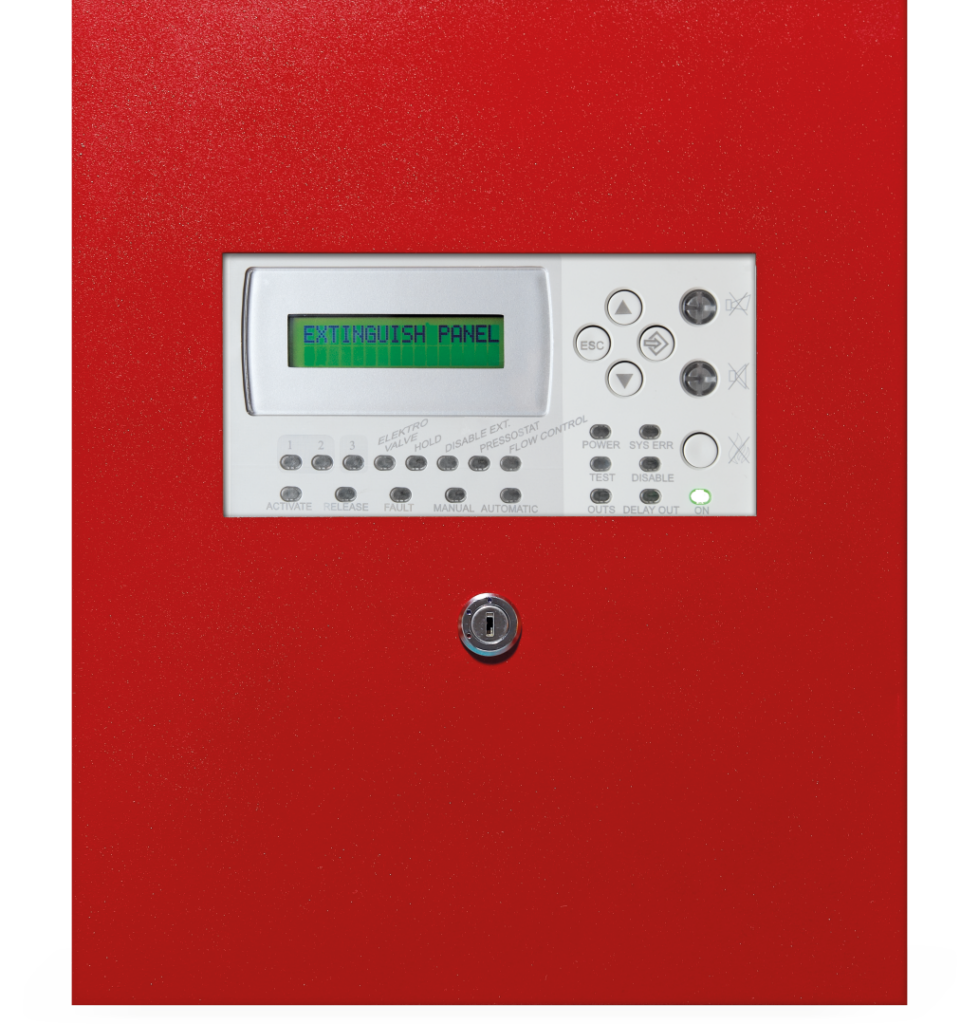
Stationary energy storage systems (BESS) require a reliable and rapid response in the event of a fire. The FP9000E fire extinguishing panel is engineered to provide effective fire security for your battery containers.
The FP9000E complies European certification under EN54 and EN 12094-1 (the standard for electrical automatic control and delay devices), guaranteeing dependable fire security and compliance with insurance requirements.
By combining 2 cross-zoned extinguishing areas, the panel implements a precise two-phase early detection of early fire, while FP9000E optimized architecture reduces installation costs.
The built-in LCD display provides clear diagnostics and system communication during on-site inspections. Through text and LED indications, maintenance personnel receive immediate clarity regarding extinguishing status, pressure, or potential system faults-without needing a laptop or specialized maintenance licenses. This ensures complete autonomy during system maintenance.
FP9000E provides effective fire extinguishing, regardless of whether the battery container is engineered for gas (Novec 1230 / FM-200), aerosol, powder, or water fire extinguishing.
Secure your BESS infrastructure with the EN 54 and EN 12094-1 certified FP9000E fire extinguishing panel, offering intelligent two-phase detection, universal compatibility with various extinguishing agents, and easy on-site maintenance.
